
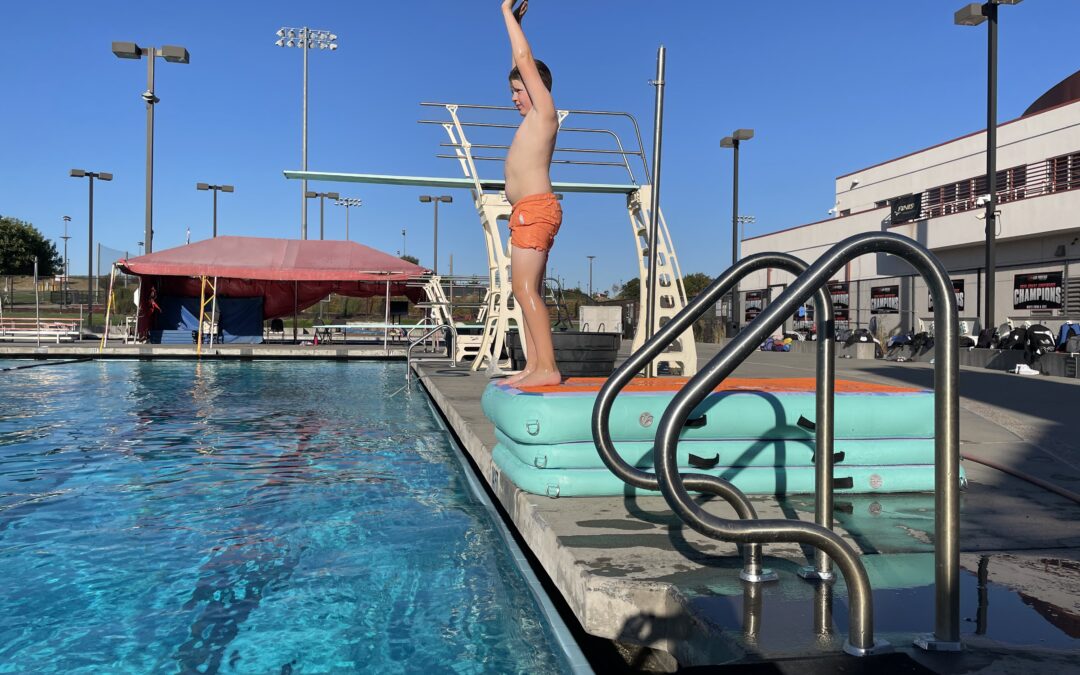
Future Champions is where most divers in our program start. It is our group for ages 5 to 13 at Las Positas College in Livermore, and no experience is needed to join. Most families find it through a free class or one of our summer camps, and then want to know what they are signing up for. This post covers what the group is for, what a practice looks like, how a diver moves up, and what it costs.
It is the first step in a year-round competitive program
We run one program at Tri-Valley Divers, year round, and Future Champions is the entry point. Every diver in the group is working toward the same goal. Learn the four basic dives (front, back, reverse, and inward) on 1 meter and a back line up on 3 meter, then move to our Junior Olympic group. We wrote about that standard in Four Dives to Join Junior Olympic.
That goal shapes how the group runs. Divers train with a consistent group on the same days each week, because skills build faster when a coach sees the same athletes in the same order every practice. We practice year round in all weather, and the only time we leave the pool is for lightning. A diver who starts in October works the same list as a diver who started in June, just from an earlier point on it.
Every diver works from the same skill list
Future Champions has three levels, Bronze, Silver, and Gold, and every skill in each level is published on our Skill Levels page. Bronze is jumps and line ups. Silver adds pike jumps, line ups on 3 meter, and the first two dives, a front tuck and an inward tuck. Gold adds the back and reverse tuck dives on 1 meter and a back line up tuck on 3 meter.
Coaches score every skill from 0 to 4 at evaluations. To move up, a diver needs at least a Good on every skill in the level, two evaluations in a row. We hold that line on purpose. A line up or a tuck jump supports every dive that comes after it, so we would rather keep a diver on a basic skill a few extra weeks than move them to a dive they are not ready for. The upside for parents is that you can see where your diver is and what comes next, and you can ask a coach for their current scores at any time.
We spend a lot of time on land
A good part of each 90 minute practice happens before anyone gets wet. Divers learn the three positions (tuck, pike, and straight), their hurdle, and their arm swing on the mats and the dry board first. The reason is simple. A diver who can hold a tight tuck on the mat can hold it in the air, and the water does not teach the shape. Land work is also where we introduce every new skill, with a spotting belt when it is needed. On the boards, the pool's bubbler system softens the water so a diver can try a new dive without the sting of a flat landing.
Everyone competes
Future Champions divers go to meets. Participation is NOT required, but we highly encourage it, because a diver who has been to a meet knows what they are training for. Local meets have events for all levels, including line ups and the basic dives, so a diver in Bronze can compete with the skills they have. We also run intersquad meets at our own pool so the first competition can happen somewhere familiar.
Before a first meet, a family needs an AAU membership and a DiveLive account, and I send out an event timeline for every meet we attend. How to Prepare Your Child for Their First Diving Meet walks through all of it.
Two coaches who have done this for a long time
Coach Monte started this club in 1980 as All Valley Divers. I coached with him from 2006 to 2013 and took over ownership of the program in 2022. Over the years the divers we have developed have gone on to compete at all levels of college diving. We limit group sizes so each diver gets enough turns on the board in a practice, and Coach Monte and I are both on deck during the week.
What it costs and when we practice
Future Champions practices Monday through Thursday from 4:00 to 5:30 pm. Two practices a week (Monday and Wednesday, or Tuesday and Thursday) is $300 a month. Four practices a week is $375 a month. Dues are based on a 4 week month, so months with 5 weeks offset months with 3 weeks. We offer a 25% discount for siblings, and every member also carries a USA Diving membership, which is $40.
We are one of the most affordable dive programs in Northern California, and we never want cost to be a limiting factor for a family, so we offer need-based scholarships to current members. The full schedule is on our Practice Schedule page.
How a diver moves up
When a diver completes Gold, they have the four dives on 1 meter and the back line up tuck on 3 meter, and they are invited to join Junior Olympic. There is no age requirement and no minimum time in the program. Joining is optional. Junior Olympic practices five days a week and costs $475 a month, so some families take the invitation right away and some wait a season, and both are fine with us. A diver who already has those skills from another program can request an evaluation.
There is no set timeline for getting to Gold. Age, practices per week, and a background in gymnastics or swimming all change it, so we do not promise a date. The list does not change, and your diver will always know the next skill on it.
Where to start
If your diver is new, come try a free class. We hold them every Wednesday. All you need is a swimsuit and a towel. Arrive 10 minutes early so we can get everyone checked in, park in Lot H at Las Positas College, and enter the pool through the red double doors. You do NOT need to purchase a parking pass.
If you have questions about the group, reply to any email from us or ask a coach on deck. Otherwise, we'll see you at the pool!